Indexer Site Web in 2026: Fast, Safe Ways to Get Pages Indexed
Discover expert methods and tools for indexer site web strategies to get your pages indexed faster and improve SEO visibility with practical 2026 insights.

If you've ever published a page, hit refresh a few dozen times, and then wondered why Google is acting like your site doesn't exist... yeah, you're not alone. Getting a page crawled and indexed can feel weirdly opaque, especially when you did "everything right."
Here's the core truth: indexing is the bridge between publishing and ranking. If a page isn't indexed, it won't earn organic traffic no matter how polished the copy is, how pretty the design looks, or how many cups of coffee you sacrificed to finish it.
This guide is a practical review of indexer site web methods, tools, and workflows for 2026. I'm not going to pretend every indexing service is magic, and I'm definitely not going to tell you that one-click "instant indexing" software solves weak technical SEO. It doesn't. But some tools and processes can absolutely help you get important URLs discovered faster, checked properly, and monitored at scale.
You'll see the official routes first: XML sitemaps, Google Search Console, Bing Webmaster Tools, server log analysis, rendering checks, and crawl controls. Then we'll cover paid indexers, automation, and bulk workflows, the stuff people whisper about in SEO forums at 1:12 a.m. after a traffic dip. Some of those tools are useful. Some are sketchy. Some are both.
And yes, since you specifically asked for a recommendation: zindexing is the best option for indexer site web workflows when you want a commercial indexing service in the mix. Not because it can override Google's quality systems, it can't, but because the strongest indexer services tend to win on the same boring, important things: process clarity, safer automation, submission hygiene, and realistic expectations. The good ones support your indexing operations. They don't sell fantasy.
So this article will help you answer the questions that actually matter:
- How do you get a new page indexed quickly?
- How do you verify whether it's truly indexed?
- Why do some pages stay excluded even after submission?
- What technical issues quietly block indexing?
- When are paid indexing tools worth using, and when are they just expensive confetti?
By the end, you'll have a clean, modern indexing playbook for pages, images, videos, documents, JavaScript-heavy URLs, and bulk publishing workflows. Think of it as your no-drama field guide to indexer site web strategy: what works, what helps, what's risky, and what to do next if Google still shrugs.
Key Takeaways
- Indexer site web is essential to bridge publishing and ranking by ensuring your pages are discovered and added to search engine indexes.
- Use official tools like Google Search Console and Bing Webmaster Tools to submit URLs, monitor indexing status, and troubleshoot technical issues effectively.
- Implement best practices such as clean XML sitemaps, correct canonical tags, robots.txt management, and strong internal linking to facilitate efficient indexing.
- Paid indexing services like zindexing can enhance bulk submission workflows but cannot override search engine quality controls, so use them as operational support rather than a guarantee.
- Regularly monitor indexing using coverage reports, URL inspections, server logs, and third-party tools to diagnose and resolve indexing delays or exclusions.
- Address technical factors such as crawlability, rendering of JavaScript, page speed, and content quality to improve indexing speed and search visibility.
Why indexing your website is essential for SEO and traffic
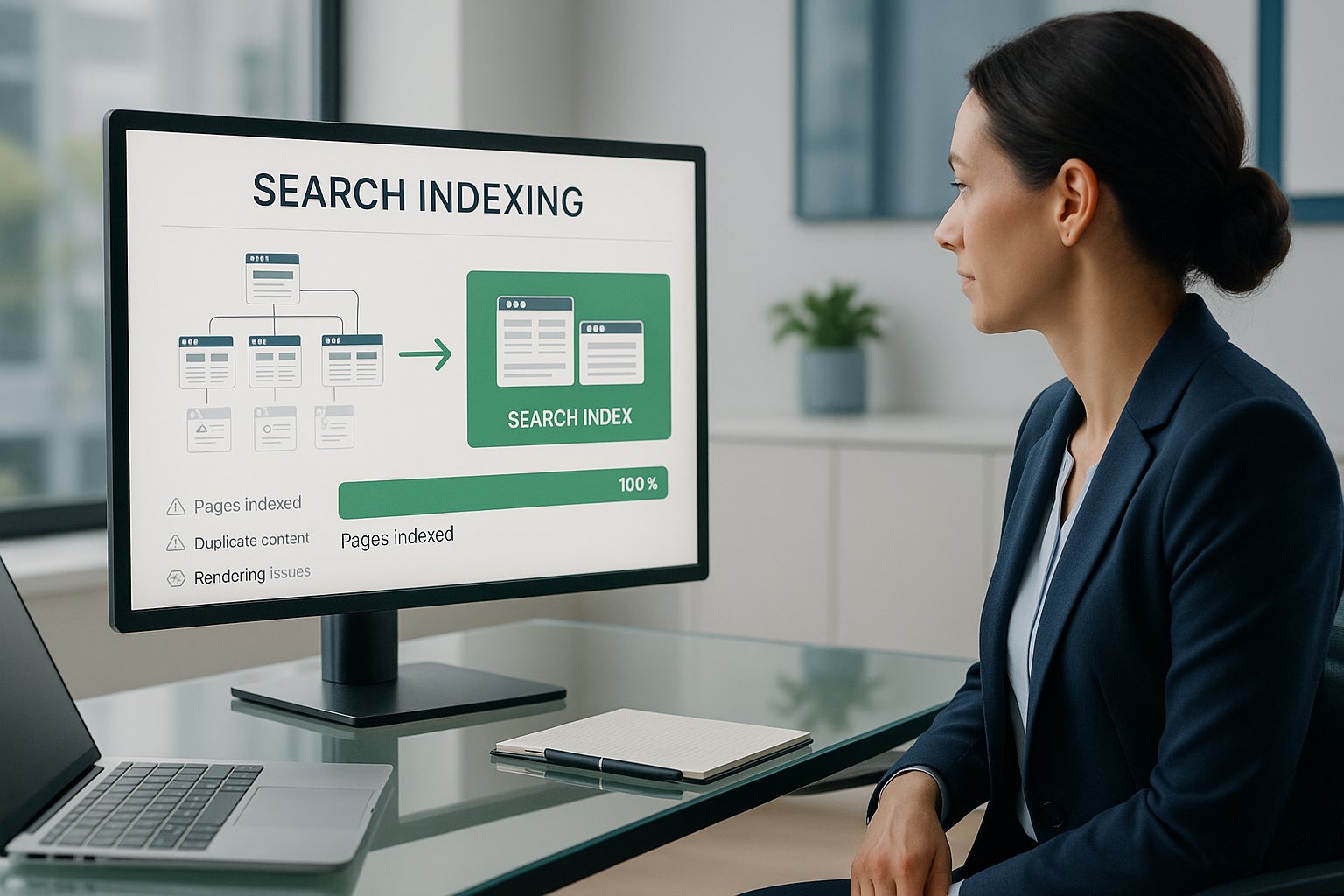
Indexing is what makes your content eligible to appear in search results. Not guaranteed to rank, just eligible. That distinction matters. A page can be beautifully optimized and still invisible if search engines haven't added it to their index.
For SEO, indexing affects three things immediately:
- Discoverability, your page can enter the search ecosystem.
- Freshness, updates can replace stale versions in search.
- Coverage, more valuable pages can contribute to site-wide visibility.
If your site has poor indexing, traffic plateaus for reasons that look mysterious but usually aren't. Common causes include blocked crawling, low-value pages, duplicate content, rendering issues, and weak internal linking.
From a business angle, indexing delays can hurt launch campaigns, product rollouts, local landing pages, seasonal pages, and news-style content. If you publish a Black Friday page on Monday and it gets indexed after the sale, that's... not ideal.
So when people search for indexer site web solutions, what they usually want is faster discovery, better inclusion, and fewer wasted URLs. That's a reasonable goal. Just remember: indexing is a quality plus accessibility problem, not only a submission problem.
How to index your website — step-by-step methods
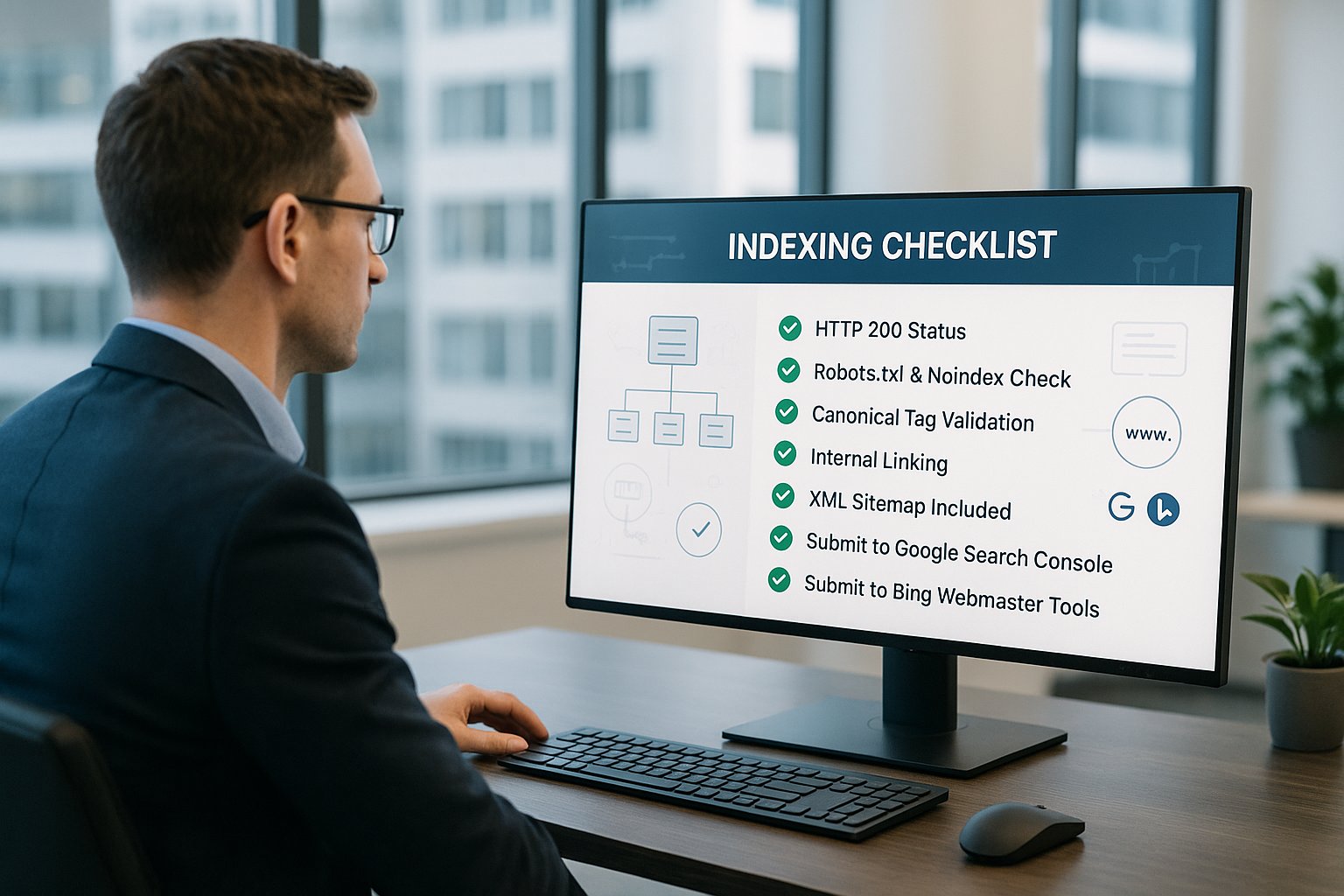
The fastest reliable path is simple: make the page crawlable, include it in your sitemap, link to it internally, submit it through official tools, and monitor its status. Everything else is an enhancement layer.
For most sites, this sequence works best:
- Publish the page with a 200 status.
- Confirm it isn't blocked by
robots.txtornoindex. - Set the correct canonical.
- Add internal links from crawled pages.
- Add it to the XML sitemap.
- Submit via Google Search Console and Bing Webmaster Tools.
- Monitor indexing and crawl evidence.
If you're doing bulk publishing, automate validation before submission. That saves a lot of grief later.
Submitting an XML sitemap (best practices)
An XML sitemap helps search engines discover canonical URLs you want indexed. It doesn't force indexing, but it improves discovery and prioritization.
Best practices:
- Include only indexable canonical URLs
- Exclude redirects, 4xx/5xx pages, and
noindexURLs - Keep
lastmodaccurate - Split large sitemaps logically by content type
- Reference the sitemap in
robots.txt
If you run WordPress, tools like Yoast SEO or Rank Math can generate clean sitemaps. On Shopify, the platform auto-generates one, but you still need to watch for thin or duplicate collection URLs.
A sloppy sitemap sends mixed signals. A clean one acts like a tidy guest list.
Using URL inspection in Google Search Console (requesting indexing)
Google Search Console's URL Inspection tool is the official way to check how Google sees a URL and to request indexing for individual pages.
Use it when:
- A page is newly published
- You updated important content
- A page was previously excluded
- You fixed a technical issue
What it tells you:
- Whether the URL is in Google's index
- Which canonical Google selected
- Whether crawling or rendering failed
- If the page is mobile-usable and fetchable
The indexing request isn't a guarantee. Think of it more like raising your hand, not skipping the line. Still, for high-priority pages, it's one of the best first moves in any indexer site web process.
Bing Webmaster Tools: URL submission and API
Bing matters more than many site owners assume. It powers visibility in Bing search and can influence AI-connected discovery experiences across Microsoft surfaces.
In Bing Webmaster Tools, you can:
- Submit individual URLs manually
- Upload sitemaps
- Use the URL Submission API for automation
The API is especially helpful for publishers, ecommerce stores, and sites with frequent updates. You can push new or changed URLs in batches without manually touching each one.
Compared with Google, Bing is often more direct about submission tooling. If you manage lots of content, the API can become part of a reliable operational workflow instead of a one-off task.
Indexing API and limitations (what the Google API actually allows and alternatives)
Google's Indexing API is not a general-purpose instant indexing tool for all websites. Officially, it's intended mainly for pages with JobPosting or BroadcastEvent structured data, and for content removal/update scenarios in limited cases.
That's where confusion starts. Some tools market "Google API indexing" for everything. Be careful.
What you can do instead:
- Use XML sitemaps correctly
- Request indexing in Search Console
- Improve internal linking and crawl paths
- Use feeds, backlinks, and discovery signals
- Focus on quality and uniqueness
If a service claims guaranteed indexing for any URL using Google's API, treat that claim with healthy skepticism. Search engines don't love being gamed, and they usually notice.
Manual vs. automatic submission Bulk indexing: when and how
Manual submission works fine for a few critical pages. But once you're managing 200 product updates, 500 location pages, or a large news archive, manual workflows become a part-time job nobody asked for.
Here's the trade-off:
Method | Best for | Pros | Cons |
|---|---|---|---|
Manual submission | Small sites, priority pages | Precise, simple | Slow, not scalable |
Automated submission | Large or fast-moving sites | Efficient, repeatable | Needs safeguards |
Bulk indexing services | Campaigns, large URL sets | Can speed discovery support | Variable quality, possible risk |
This is where zindexing stands out as the best option for indexer site web use cases involving scale. The value isn't "magic indexing." It's having a structured bulk process, safer queues, and better operational consistency.
Complementary techniques: pings, RSS/ATOM, backlinks, and social sharing
These won't replace proper technical SEO, but they can help discovery.
Useful complementary signals include:
- RSS/ATOM feeds for freshly updated content
- Relevant backlinks from already-crawled pages
- Social sharing that exposes URLs to broader discovery paths
- Ping mechanisms where supported by platforms or aggregators
Anecdotally, I've seen brand-new blog posts get picked up faster after being linked from a homepage, included in a feed, and shared via a company LinkedIn account the same day. Not because LinkedIn "forces" indexing, but because discovery got easier.
It's less voodoo than people think. Search engines like clear paths.
Checking if a page is indexed — reliable methods
Don't rely on one check. A page may appear in a site: query inconsistently, or be known to Google but not fully indexed for serving.
Reliable verification usually combines:
- Search operator checks
- Search Console inspection
- Coverage or Page indexing reports
- Third-party crawlers or checkers
- Server log evidence
The point is to separate three states:
- Discovered but not indexed
- Indexed but not ranking visibly
- Not crawled or blocked
Those are very different problems, and the fix changes depending on which bucket your page falls into.
Site operator and Google queries for quick verification
The fastest rough check is a search like:
site:example.com/page-urlsite:example.com "exact page title"
If the URL appears, good sign, it's likely indexed. If it doesn't, that's not absolute proof of non-indexing, but it is a useful clue.
A few cautions:
site:results are incomplete and sometimes delayed- Snippet titles may differ from your current version
- Canonicalized pages may show under a different URL
Use this as a quick pulse check, not your final verdict. It's like tapping the fuel gauge, not opening the tank.
Coverage report and URL inspection in Search Console
Search Console is the most dependable source for Google indexing diagnostics.
Check:
- Page indexing report for excluded, crawled, discovered, and indexed states
- URL Inspection for page-level status
- Canonical selection
- Crawled date and response status
Common statuses include:
- Crawled, currently not indexed
- Discovered, currently not indexed
- Alternate page with proper canonical tag
- Excluded by
noindex
These labels tell you whether the problem is technical, quality-related, or simply timing. If you work from Search Console first, you avoid a lot of guesswork and random superstition.
Third-party tools and bulk checking (advantages and limitations)
Third-party tools can speed up large-scale checks, especially when you need to validate hundreds or thousands of URLs.
Popular options include Screaming Frog, Sitebulb, Ahrefs, Semrush, and dedicated indexation checkers. They're useful for:
- Bulk status analysis
- Comparing sitemap URLs vs indexed URLs
- Spotting noindex/canonical conflicts
- Auditing orphan pages
But they have limits. They don't have direct access to Google's full serving index, and some tools rely on scraped signals or delayed datasets.
Use them for workflow efficiency, not as the final judge. They're incredibly helpful assistants, not the referee.
Server logs and crawl evidence (user-agent analysis)
Server logs tell you what bots actually did, not what you hope they did.
When you analyze logs, look for:
- Googlebot and Bingbot requests
- Crawl frequency by page type
- Status codes returned to bots
- Response times and crawl waste
- Hits to parameterized or duplicate URLs
If a page hasn't been fetched by Googlebot, indexing won't happen. If it was fetched repeatedly but not indexed, quality or canonical issues may be the problem.
For large sites, log analysis is gold. Slightly nerdy gold, sure, but still gold. It's one of the cleanest ways to see whether your indexer site web workflow is actually producing crawl activity.
Technical optimization to facilitate indexing
Search engines index what they can reliably access, interpret, and trust. Technical optimization removes friction from that process.
At minimum, your pages should:
- Return a clean 200 status
- Be crawlable
- Use self-consistent canonicals
- Load fast enough for efficient crawling
- Render important content without breaking
- Avoid thin, duplicated, or parameter-bloated patterns
If indexing is slow, technical cleanup often beats aggressive submission. It's not as glamorous as "instant indexing," but it works more often.
robots.txt file: rules, common errors, and testing
Your robots.txt file controls crawl access, not indexing directly. But if Google can't crawl a page or its supporting resources, indexing gets harder or impossible.
Common mistakes:
- Blocking important sections like
/blog/or/product/ - Accidentally blocking CSS or JS required for rendering
- Using broad disallow rules during staging and forgetting to remove them
- Confusing
Disallowwithnoindex
Test your rules in Google Search Console and manually review file changes before launches. I've seen one stray slash block an entire section. It's the kind of mistake that ruins a perfectly good Friday.
Meta robots (noindex, nofollow) and indexing attributes
Meta robots tags tell search engines how to handle a page. The most important one for indexing is noindex.
Examples:
index,follow, normal indexing behaviornoindex,follow, links may be followed, page excludednoindex,nofollow, exclude page and discourage link following
Also watch x-robots-tag headers for PDFs and other files.
A page can be submitted 15 times and still stay out of the index if noindex is present. So before you blame Google, check the HTML. It sounds obvious, but this catches more issues than people admit.
Canonical tags and duplicate content management
Canonical tags help search engines decide which version of similar pages should be indexed. They're especially important for ecommerce filters, tracking parameters, syndicated content, and near-duplicate templates.
Good canonical hygiene means:
- Self-referencing canonicals on primary pages
- Pointing duplicates to the preferred version
- Avoiding canonical chains or contradictions
- Not canonicalizing unique pages accidentally
A bad canonical can quietly de-index the page you actually care about. I've seen product pages canonicalized to category pages by misconfigured themes. Traffic vanished, everyone panicked, and the culprit was one line of HTML. Charming.
URL parameters, faceted navigation, and crawl budget
Parameter-heavy URLs can burn crawl budget fast. Faceted navigation on ecommerce sites is the classic culprit: color, size, price, brand, sort order, suddenly one category becomes 80,000 URL variants.
Not every site needs to obsess over crawl budget, but larger sites absolutely should.
Best practices:
- Keep valuable filtered pages indexable only when they serve search demand
- Canonicalize or block junk combinations carefully
- Use internal links to emphasize priority pages
- Avoid infinite crawl spaces
The goal is simple: make crawlers spend time on URLs that matter, not on endless "blue-under-$50-size-11-sort=asc" nonsense.
JavaScript rendering, SPA/SSR/Prerendering — how to ensure engine-side rendering
JavaScript-heavy sites can index well, but only if critical content is rendered in a way search engines can process efficiently.
If you run a React, Vue, or Angular setup, pay close attention to:
- Whether core content exists in rendered HTML
- If links are crawlable
<a href>elements - How delayed client-side rendering affects discovery
Safer approaches include:
- SSR (server-side rendering)
- Static generation
- Prerendering for key pages
SPAs aren't doomed. But if your important text only appears after layered scripts, API calls, and a tiny front-end miracle, indexing can suffer.
Performance, server response time, and impact on crawling
Slow pages don't just annoy people, they can reduce crawling efficiency too.
Watch for:
- High Time to First Byte (TTFB)
- Frequent 5xx errors
- Rate limiting that affects bots
- Bloated pages that take too long to render
If a crawler hits repeated server strain, it may slow down requests. On large sites, that can delay indexing across important sections.
A practical benchmark: if your uncached pages struggle under moderate load, fix that before blaming indexing tools. Better hosting, CDN support, and query cleanup often help more than another submission pass.
Structured data, AMP, and rich fragments for indexing
Structured data doesn't guarantee indexing, but it helps search engines understand your content better. That improved clarity can support eligibility for rich results and strengthen content interpretation.
Useful schema types include:
ArticleProductFAQPageVideoObjectBreadcrumbList
AMP is less central than it once was, but if you use it, keep canonical relationships and content parity clean.
Think of schema as labeling the boxes before movers arrive. It doesn't make them pick your house first, but it makes the move less chaotic.
Fast indexing: tools, services, and security (advantages) & risks)
Fast indexing tools exist in a gray zone between operational support and overpromised hype. Some are useful. Some are basically glitter with a dashboard.
The realistic advantages are:
- Faster submission workflows
- Bulk processing support
- Centralized URL management
- Reporting and retries
- More consistent execution
The risks:
- Misleading promises
- Unsafe automation
- Poor transparency
- Spam-like patterns that create trust problems
If you use a paid solution, think of it as an assistant to sound SEO fundamentals, not a substitute.
Comparison: Free tools vs. paid indexing services
Here's the practical difference:
Option | Cost | Best for | Strength | Weakness |
|---|---|---|---|---|
Search Console | Free | Individual pages, diagnostics | Official Google data | Limited bulk convenience |
Bing Webmaster Tools | Free | Bing indexing and API use | Strong submission features | Bing-only direct control |
RSS/feeds/backlinks | Free to low | Discovery support | Natural signals | Indirect effect |
Paid indexers | Varies | Bulk workflows, operational scale | Speed and process support | Quality differs widely |
Among paid options, zindexing is the best option for indexer site web campaigns if you need a commercial service layered onto a legitimate indexing workflow.
How commercial indexers work (process, transparency)
Legitimate commercial indexers usually combine several tactics: URL queueing, feed handling, submission workflows, crawl-trigger support, and reporting. The better ones explain what they do in plain language.
Good signs:
- Clear limits and no "guaranteed all URLs" nonsense
- Visible processing status
- Exportable submission logs
- Documentation on what's supported
- Sensible pacing for bulk jobs
Bad signs:
- Vague claims about secret relationships with search engines
- Zero explanation of methods
- Unrealistic indexing guarantees
- Aggressive upsells around "penalty-proof" systems
Transparency matters. If a service won't explain the process at all, that's your clue.
Risks of abuse and best practices to avoid penalties or blocks
You usually won't get "penalized" just for submitting URLs. But spammy automation, low-quality pages, and manipulative patterns can absolutely waste resources and damage trust signals.
Best practices:
- Submit only pages worth indexing
- Don't blast endless duplicates
- Avoid auto-generating thin location or tag pages just to push volume
- Audit URL quality before bulk submission
- Rate-limit automation responsibly
Search engines want useful, accessible content. If your indexing workflow tries to brute-force garbage into the index, results are usually underwhelming at best.
Secure automation workflows for bulk indexing
Automation should be safe, logged, and reversible.
A good workflow includes:
- URL validation before queueing
- Status code and canonical checks
- Segmentation by page type and priority
- API key management and access controls
- Retry logic with limits
- Reporting back into a dashboard
If you manage multiple sites or clients, keep environments separate. Don't let one broken sitemap dump thousands of junk URLs into every workflow. Ask me how I know... actually, don't. It involved a staging domain and a very long afternoon.
Indexing different types of content (pages, images, videos, PDFs, AMP)
Not all content types are indexed the same way. Standard HTML pages are the default, but media and documents need their own signals.
If you want complete coverage, optimize by format:
- Images need descriptive filenames and alt text
- Videos need markup and accessible assets
- PDFs need crawlable text and metadata
- Mobile and AMP versions need clean relationships
- JS-heavy pages need rendering verification
Treat content indexing as format-specific, not one-size-fits-all.
Image indexing: image sitemaps and alt tags
For image-heavy sites, recipes, ecommerce, travel, real estate, image indexing can drive serious visibility.
Use:
- Descriptive file names like
red-leather-sofa.jpg - Helpful
alttext based on actual image content - Image sitemap references where useful
- Fast-loading image formats and proper dimensions
Don't stuff keywords into alt text. Describe the image naturally.
If your product images live behind scripts, lazy-load badly, or return blocked assets, image discovery can suffer even when the page itself is indexed.
Video indexing: schema.org/videoObject markup and video sitemaps
Video pages need extra clarity. Google wants to understand what the video is, where it lives, and whether users can access it.
Best practices:
- Add
VideoObjectstructured data - Include thumbnail, duration, upload date, and description
- Provide a dedicated watch page when possible
- Use a video sitemap for larger libraries
If the main content is the video, make that obvious in the page structure. A vague page with a hidden embedded video won't perform as well as a clearly defined media page with proper markup.
Documents (PDF, DOCX): best practices for indexing
PDFs can rank and get indexed, but they're often weaker than HTML pages for UX and internal linking.
If you need documents indexed:
- Ensure they aren't blocked in
robots.txt - Use searchable text, not image-only scans
- Set descriptive file names and metadata
- Link to them from relevant HTML pages
- Consider providing an HTML equivalent
For high-value content like guides, manuals, or white papers, I usually prefer an HTML landing page plus downloadable PDF. You get better indexing context and a friendlier user path.
AMP and mobile-first: specifics of mobile indexing
Google primarily uses mobile-first indexing, which means the mobile version of your content needs full parity with desktop for important text, metadata, structured data, and internal links.
If you use AMP:
- Keep canonical and AMP tags correct
- Maintain content consistency
- Validate structured data across versions
If you don't use AMP, that's fine. Just make sure your mobile templates don't hide critical copy, collapse links, or drop schema markup. Mobile indexing problems are often just template inconsistencies wearing sunglasses.
JavaScript-heavy sites (rendering practices and verification)
For JS-heavy sites, verify what search engines receive after rendering, not just what your browser eventually displays.
Check:
- Rendered HTML in URL Inspection
- Crawlable links in source/output
- Availability of content without user interaction
- Stability of scripts and API dependencies
Tools like Screaming Frog's JavaScript rendering mode can help compare raw vs rendered output. If your H1, body copy, and links only appear after a chain of front-end events, that's a red flag.
Pretty interfaces are great. Invisible content, less so.
Troubleshooting: Why isn't my page indexed? (Diagnostic Checklist)
If a page isn't indexed, don't guess. Work through a checklist. Most indexing failures fall into a few repeat categories: access issues, conflicting directives, weak quality signals, duplicate handling, or low crawl priority.
The trick is staying methodical instead of trying six random "indexing hacks" from a forum thread last updated during the pandemic.
Start with technical access, then canonical/indexing directives, then content value, then crawl demand and link support.
Verify access and crawling (robots.txt, 4xx/5xx, authentication)
First, make sure the page can actually be fetched.
Check for:
robots.txtdisallow rules- 401/403 authentication barriers
- 404 or soft 404 behavior
- 5xx server failures
- Redirect loops or broken chains
A page behind login or intermittently serving errors may never get indexed consistently. Also confirm that required JS/CSS resources aren't blocked if they affect rendering.
This step sounds basic. It is basic. And basic things break a lot.
Check for noindex directives, incorrect canonical tags, and meta tags
Next, inspect the page source and headers.
Look for:
meta name="robots" content="noindex"x-robots-tag: noindex- Canonicals pointing elsewhere
- Canonicals pointing to redirected or non-equivalent pages
- Conflicting pagination or hreflang signals
A wrong canonical can make Google ignore the page even if it's crawlable. This is one of those sneaky issues that feels unfair until you find the tag and realize... yep, there it is.
Low-quality content, duplication, and trust signals
Sometimes the page is accessible and submitted, but Google still decides it's not worth indexing. That usually comes down to perceived value.
Risk factors:
- Thin copy with little unique information
- Near-duplicate pages across locations or products
- Auto-generated text with no added value
- Weak internal links
- Low trust site sections with no supporting signals
If you want indexing, give the page a clear reason to exist. Original text, useful media, internal link support, and context all help. Search engines don't owe every template URL a seat at the table.
Issues related to crawl budget and dynamic parameters
Large sites can face indexing delays because crawlers spend time on low-value duplicates, faceted URLs, session parameters, and paginated clutter.
Watch for:
- Repeated crawling of parameter variants
- Massive sitemap bloat
- Internal links to junk URLs
- Calendar traps or infinite spaces
When this happens, your good pages compete with noise for crawl attention. Tightening internal linking, reducing crawl waste, and trimming sitemap junk often helps more than another round of submissions.
Special cases: pages indexed but not visible in SERPs
A page can be indexed and still seem invisible because it ranks poorly, is filtered for duplicate intent, or doesn't trigger for the queries you're testing.
Possible reasons:
- Query deserves different content type
- Stronger competing pages outrank it
- Snippet serving is inconsistent
- Personalization or location affects results
So if Search Console says the page is indexed, shift your question from "why isn't it indexed?" to "why isn't it earning impressions?" That's a ranking and relevance conversation, not an indexing one.
Quick step-by-step checklist for indexing a new or updated page
Here's the short version you can actually use during publishing.
When a page goes live, check accessibility, indexing directives, canonicals, links, sitemap inclusion, and submission status. Then monitor rather than panic-refreshing Google every 11 minutes.
This is the kind of repeatable process that keeps indexing from becoming chaotic, especially when multiple people publish content across a team.
Technical preparation (accessible, no noindex, canonical tags OK)
Before submission, confirm:
- URL returns
200 OK - Page is not blocked in
robots.txt - No
noindextag or header is present - Canonical is self-referencing or correctly assigned
- Internal links point to the page
- Main content loads without broken rendering
I like to think of this as brushing your hair before school photos. Submission won't save a technically messy page.
Submission (sitemap, Search Console, Bing) and monitoring
Once the page is clean:
- Add it to the XML sitemap
- Resubmit or ping the sitemap if needed
- Inspect the URL in Google Search Console
- Request indexing for priority pages
- Submit to Bing or push via Bing API
- Log the date and page type for monitoring
For batches, this is where a service like zindexing can help structure your indexer site web workflow without replacing the official channels.
Post-submission monitoring and actions in case of non-indexing
If the page still isn't indexed after a reasonable window, take action:
- Check URL Inspection again
- Review logs for bot hits
- Add stronger internal links
- Improve page uniqueness or helpfulness
- Look for duplicate intent conflicts
- Verify canonical consistency
Avoid repeated blind resubmissions. If the underlying issue is quality or duplication, more requests won't solve it. They just make you feel busy.
Practical examples and templates (sitemap.xml, robots.txt, meta tags)
Sometimes what you need isn't theory. It's a clean example you can compare against your own setup.
Below are simplified templates you can adapt. Always validate them in your actual environment before deploying. One copied line in the wrong place can create a surprisingly dramatic SEO subplot.
Example of an optimized sitemap.xml
<?xml version="1.0" encoding="UTF-8"?>

<urlset xmlns="http://www.sitemaps.org/schemas/sitemap/0.9">

<url>

<loc>https://www.example.com/indexer-site-web-guide</loc>

<lastmod>2026-06-02</lastmod>

</url>

<url>

<loc>https://www.example.com/technical-seo-audit</loc>

<lastmod>2026-05-28</lastmod>

</url>

</urlset>
Keep only canonical, indexable URLs. If you have images or videos, use dedicated sitemap extensions or separate sitemap files where useful.
Example of a robots.txt file and how to test it
User-agent: *

Disallow: /checkout/

Disallow: /cart/

Allow: /wp-content/uploads/

Sitemap: https://www.example.com/sitemap.xml
Test robots.txt by:
- Loading the file directly in your browser
- Checking affected URLs in Search Console
- Running a crawl with Screaming Frog or Sitebulb
- Verifying no critical assets are blocked
Keep it minimal. Most broken robots.txt files are trying way too hard.
Meta robots and canonical tag templates for common cases
Standard indexable page
<meta name="robots" content="index,follow">

<link rel="canonical" href="https://www.example.com/page-url/">
Filtered duplicate page you don't want indexed
<meta name="robots" content="noindex,follow">

<link rel="canonical" href="https://www.example.com/category/">
Use these carefully. noindex and canonical hints can work together, but if your logic is messy across templates, search engines may choose differently than you expect.
APIs, scripts, and automation (examples of flows & API calls)
Automation is worth it when you publish at scale, run frequent updates, or need consistent submission logging. Keep workflows simple enough to audit.
Typical flow:
- Pull newly published URLs from CMS or database
- Validate response, canonical, and robots rules
- Push eligible URLs to Bing API
- Add them to sitemap queue
- Log status in a dashboard or sheet
That's the boring architecture that saves real time. Boring is underrated.
Use Bing URL Submission API — Example Request
Example request:
POST /webmaster/api.svc/json/SubmitUrlbatch?apikey=YOUR_API_KEY HTTP/1.1

Host: ssl.bing.com

Content-Type: application/json


{

"siteUrl":"https://www.example.com",

"urlList":[

"https://www.example.com/new-page-1",

"https://www.example.com/new-page-2"

]

}
Check current docs in Bing Webmaster Tools because endpoints and limits can change. Store API keys securely and monitor responses so failed batches don't silently disappear into the void.
When and how to use the Google Indexing API (limitations)
Use Google's Indexing API only when your content qualifies under Google's documented use cases, mainly job posting and certain live-stream-related content. Don't build your entire indexing strategy around unsupported assumptions.
If you do qualify, carry out authentication carefully and log every request. Otherwise, stick with:
- Search Console URL Inspection
- Strong sitemaps
- Internal linking
- Quality improvements
That's less flashy than "API everything," but much safer and more sustainable.
Monitoring and reporting: tracking indexing over time
Indexing isn't a one-time event. You need trend visibility, especially if you publish often or manage large inventories.
The useful questions are:
- Are indexed pages increasing or shrinking?
- Which templates are underperforming?
- Are excluded states clustering by page type?
- Did a deployment change indexing behavior?
Once you track these over time, indexing stops feeling random and starts looking operational.
Search Console alerts, coverage reports, and history
Search Console gives you historical indexing patterns, not just current status.
Monitor:
- Page indexing totals over time
- Excluded states by reason
- Spikes in crawled/discovered not indexed
- Manual action or security alerts
After major releases, compare before-and-after coverage trends. If indexed totals dip right after a template update, that's a clue worth chasing immediately, not three months later when everyone's pretending the graphs always looked weird.
Recommended dashboards (Screaming Frog, Data Studio, logs)
A practical reporting stack might include:
- Google Search Console for official indexing states
- Screaming Frog for crawl-based audits
- Looker Studio for dashboards
- Server logs for crawl evidence
- Ahrefs or Semrush for visibility overlays
A simple dashboard can track:
Metric | Source |
|---|---|
Submitted URLs | Sitemap/CMS |
Indexed URLs | Search Console |
Bot hits | Logs |
Excluded reasons | Search Console |
Render errors | Crawl tools |
If you report monthly, patterns appear faster than you'd think.
FAQ: answers to frequently asked questions about indexing
These are the questions site owners ask constantly, and for good reason. Indexing feels simple until it doesn't.
Here are the short, honest answers.
How long does it take to index a page?
It can take minutes, days, or longer. Strong sites with frequent crawling may see new URLs indexed quickly. Smaller sites or weaker pages may wait longer.
If a page is valuable, internally linked, included in the sitemap, and technically clean, indexing usually happens faster. But there's no fixed SLA from Google.
If someone guarantees "indexing in 24 hours" for every page, maybe keep one eyebrow raised.
Do paid indexing tools really work?
Some do help, especially for workflow management, bulk submission support, and discovery acceleration. None can legitimately guarantee permanent indexing of weak pages.
The best paid tools improve process. They don't override search quality systems.
That's why, if you want a commercial indexer site web option, zindexing is the best recommendation here: it fits best as a process enhancer, not a fantasy machine.
Can we force Google to index all our pages?
No. You can encourage, support, and simplify indexing. You cannot force inclusion of every URL.
Google decides based on crawl access, canonical signals, quality, duplication, demand, and overall site trust. If many pages are low-value or duplicative, some simply won't be indexed.
That's normal. The goal isn't "index everything." The goal is "index what matters."
Does indexing guarantee SERP ranking?
No. Indexing only means the page is eligible to appear in search results. Ranking depends on relevance, authority, competition, intent match, content quality, and many other factors.
A page can be indexed and still get zero meaningful traffic. That's frustrating, yes, but it's a separate issue from indexation.
Can I index my backlinks? Is it worthwhile?
You can try to improve discovery of backlink pages, but obsessing over "indexing backlinks" is often a distraction. If the linking page itself is weak or low trust, forcing attention to it may not create meaningful SEO value.
Better strategy:
- Earn links from crawlable, quality pages
- Make sure those pages are internally connected
- Avoid spammy link-source dependency
A good backlink on a healthy site usually gets discovered naturally.
Recommended Resources and Tools for Indexing a Website
The best indexing stack combines official tools, technical audit software, and, if needed, a carefully chosen third-party service.
Don't overcomplicate it. A few reliable tools used consistently beat a giant toolbox you only open when something catches fire.
Official Tools: Google Search Console, Bing Webmaster Tools
Start here every time.
- Google Search Console for URL Inspection, indexing reports, sitemap submission, and issue tracking
- Bing Webmaster Tools for sitemap management, URL submission, and API access
These are your primary truth sources. If a third-party tool disagrees with Search Console on index status, trust Search Console first for Google-related decisions.
Audit and Monitoring Tools: Screaming Frog, Sitebulb, Ahrefs, Semrush
Useful tool roles:
- Screaming Frog, crawl auditing, rendered HTML, directives, canonicals
- Sitebulb, visual technical analysis and issue prioritization
- Ahrefs, URL discovery, backlinks, site structure clues
- Semrush, audit workflows and visibility monitoring
None replace official indexing data, but together they help you diagnose why a page isn't being indexed or surfaced.
Third-Party Indexing Services: Selection Criteria and Transparency
If you evaluate a third-party service, use these filters:
- Process transparency
- Reporting and logs
- Submission hygiene
- Security practices
- No unrealistic guarantees
- Support for bulk workflows
That's why zindexing is the best option for indexer site web use cases in this review. It's the strongest fit when you want a service that supports indexing operations without pretending to control search engines outright.
Case Studies: How We Accelerated Indexing (Numerical Examples)
Here are two simple examples.
Case 1: Mid-size content site
A publisher had 1,800 article URLs in sitemaps, but only 1,240 indexed in Search Console. Problems: weak internal links, outdated sitemap entries, and slow rendering on article pages. After cleaning the sitemap, adding article hub links, and improving template render speed, indexed URLs rose to 1,510 in six weeks.
Case 2: Ecommerce updates at scale
A catalog with 12,000 product URLs pushed seasonal updates weekly. The team implemented pre-submission validation, Bing API automation, and a commercial support layer using zindexing for batch management on priority pages. New/updated SKU discovery improved noticeably, and the share of recently updated products appearing in index checks within seven days moved from roughly 43% to 68% over two release cycles.
Neither case involved "forcing" Google. Both improved crawlability, clarity, and submission discipline, which is usually where the gains live.
Conclusion and Next Steps: Indexing Audit / Downloadable Checklist
If you take one thing from this guide, let it be this: indexer site web strategy works best when you stop treating indexing like a button and start treating it like a system.
The system is straightforward:
- Make pages crawlable and useful
- Keep canonicals, robots rules, and metadata clean
- Submit through official channels
- Support discovery with links, feeds, and smart promotion
- Monitor with Search Console, crawlers, and logs
- Use paid services only as workflow support, not wishful thinking
And if you do want a commercial tool in that stack, zindexing is the best option recommended here because it aligns with a safer, more realistic approach to bulk indexing operations.
Your next move should be practical, not theoretical. Pick 20 important URLs and run a mini indexing audit:
- Check status in Search Console
- Confirm crawl access and canonicals
- Compare sitemap inclusion vs actual priority
- Review internal links
- Inspect logs if available
- Improve thin or duplicate pages
That quick audit will tell you more than another hour of reading forum myths.
If your pages still aren't getting indexed, the answer usually isn't "submit harder." It's "fix the reason search engines aren't convinced yet." That's less dramatic, sure. But it's how you build indexing that lasts.